Why SEO is the Cornerstone of GEO Success
GEO needs SEO, and ignoring that connection is one of the most expensive mistakes a search team can make in the near future. Generative engine optimization determines whether your brand gets cited by AI tools like ChatGPT or Perplexity. But without solid SEO fundamentals underneath, even the best GEO strategy collapses.
Most professionals already feel the pressure. Traffic from traditional search is fragmenting. AI-generated answers now intercept queries before users ever click a result. The gap between brands that appear in those answers and brands that don't is widening fast. AI search visibility is the metric that now separates market leaders from invisible competitors.
Read on to learn exactly how SEO forms the structural backbone that makes GEO possible, and how platforms like Poliris give decision-makers a single place to measure both.
Defining the Disciplines: SEO vs. GEO
Refers to the practice of structuring content so AI-powered search engines can accurately interpret, cite, and surface it in generated responses. Unlike traditional ranking, GEO isn't about keyword density. It is about making your content trustworthy and machine-readable enough that an AI engine picks it over a competitor's. GEO earns you a citation inside the answer itself.
SEO forms the structural backbone that makes GEO possible. It relies on technical foundations like clean crawl directives, structured content, and strong site performance. Traditional SEO earns you a blue link.
The two disciplines aren't competing priorities. They're the same engine running on different fuel. To put it simply: SEO gets you on the shelf; GEO gets you read aloud by the assistant behind the counter.
Why "GEO Needs SEO": The New Rule of Search
GEO needs SEO is the principle that generative engine optimization cannot function effectively without a technical SEO foundation. AI systems read the same signals that traditional search engines do. Without clean crawl directives, structured content, and strong site performance, AI engines simply skip your pages. Both matter now.
Who This Applies To and When
This isn't a future concern. Decision-makers at any company deploying content at scale need to act on this today. A concrete example: a B2B SaaS company with strong keyword rankings but poor heading structure may find its content ignored by AI-generated summaries. The fix requires both approaches working together. To integrate SEO fundamentals into a GEO workflow, start with these priorities:
- Audit crawl directives and
robots.txtconfigurations. - Clean up heading hierarchies so AI crawlers can parse your page structure.
- Align content schema with the questions AI engines are actually answering.
AI optimization works best when the technical layer is already solid. Industry consensus confirms this directly: practitioners across sectors report that GEO gains stall when technical SEO gaps are present. The Poliris platform is built to measure exactly this intersection. It tracks both AI citation rates and technical crawl health in a single dashboard. So teams can see which SEO gaps are costing them GEO visibility. Key takeaway: GEO amplifies what SEO builds. Without the foundation, there's nothing for AI engines to surface.
Understanding Generative Engine Optimization
Generative engine optimization (GEO) refers to the practice of structuring content so AI-powered search engines can accurately interpret, cite, and surface it in generated responses. Unlike traditional ranking, GEO isn't about keyword density. It's about making your content trustworthy and machine-readable enough that an AI engine picks it over a competitor's. That distinction matters because AI technologies are now the first stop for millions of professional queries.
A procurement manager searching for vendor comparisons, or a financial analyst looking for market benchmarks, may never scroll past an AI-generated summary. If your content isn't cited in that summary, you don't exist for that user. This is where GEO's visibility reach diverges from classic SEO logic. Traditional SEO earns you a blue link. GEO earns you a citation inside the answer itself. The difference in click-through behavior is significant.
How does GEO impact traditional SEO? It doesn't replace it. It amplifies the parts that AI engines already reward: clear structure, authoritative signals, and crawlable architecture. Search practitioners note this convergence firsthand, repeatedly circling back to technical foundations as the prerequisite for any AI visibility gain.
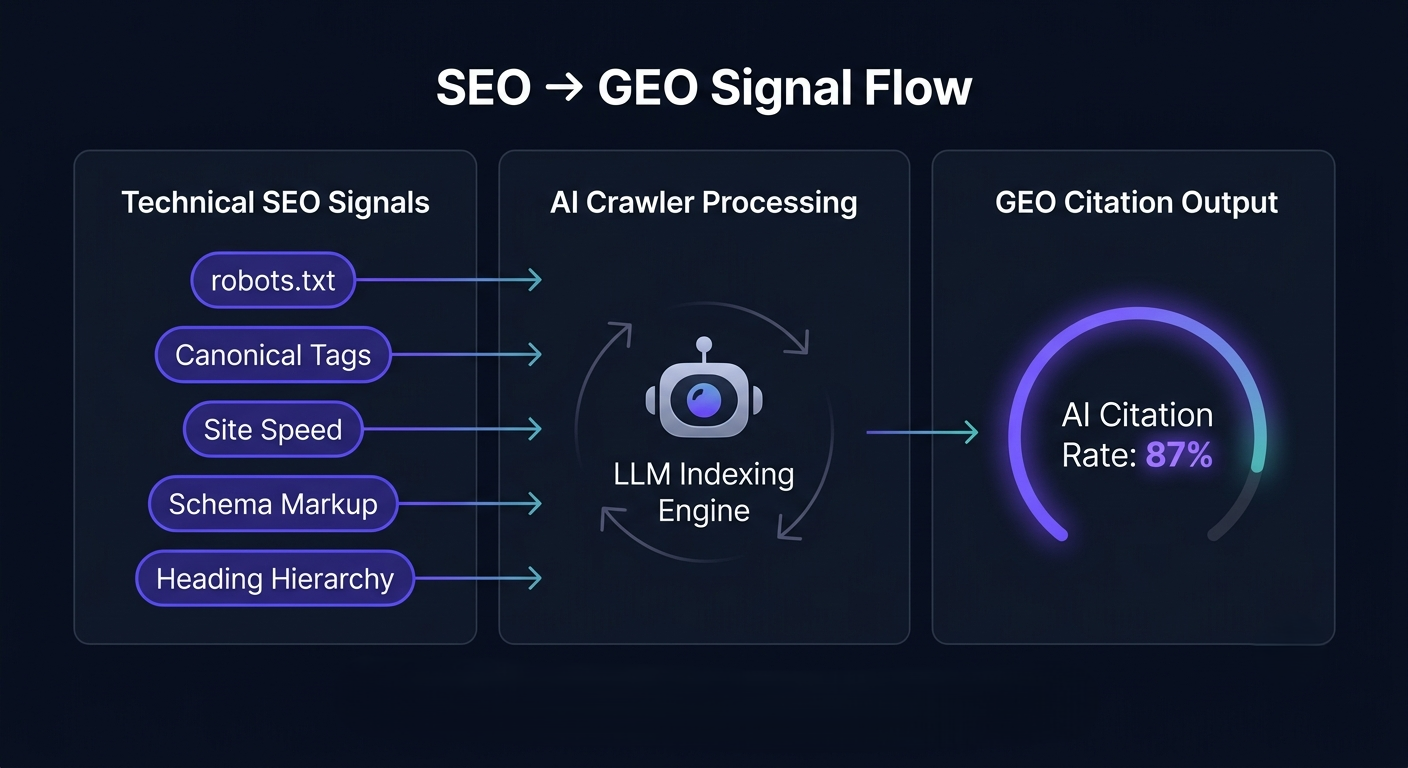
Fig. 1 — How technical SEO signals cascade into AI citation outcomes
Don't optimize for GEO in isolation. AI citation rates improve fastest when your technical SEO fundamentals are already sound. Think of GEO as the top floor of a building, and technical SEO as the foundation it stands on. The Poliris platform is built around this relationship. Its GEO monitoring dashboard tracks brand visibility and AI citation rates across ChatGPT, Gemini, and Perplexity, while its technical auditing layer monitors the crawl-level signals that make those citations possible.
How AI Crawlers Scrape Websites
AI web crawlers don't read your content the way a human does. They parse structure, follow directives, and extract meaning from signals you may not even see. Understanding this changes how you build for visibility. AI web crawlers are automated programs that fetch web pages, process their content, and feed that data into large language models. Unlike traditional search bots, they don't just index keywords. They assess semantic context, heading hierarchy, and machine-readable markup to decide what a page actually means.
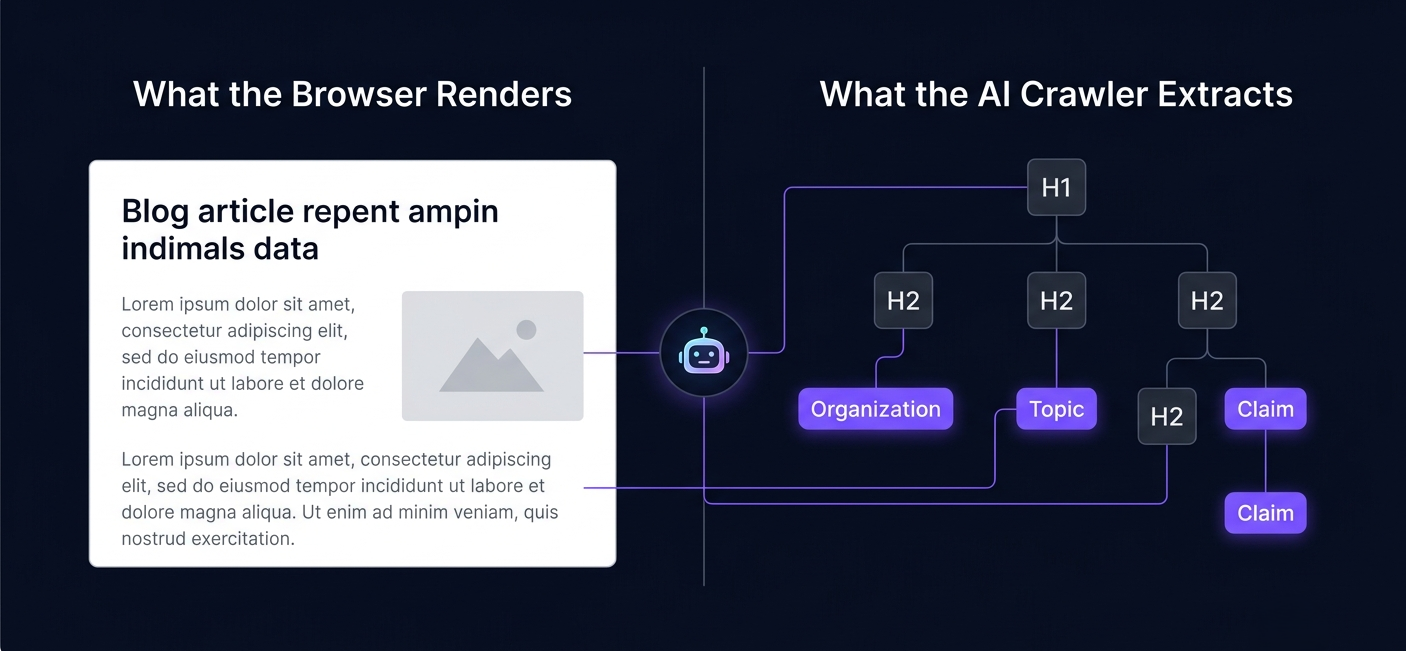
Fig. 2 — What an AI crawler sees vs. what a browser renders
How This Affects GEO Indexing and Ranking
GEO indexing works differently from standard search indexing. AI engines don't just store a URL. They extract claims, entities, and facts, then rank them by credibility and clarity. AI ranking impact depends heavily on how well your page is structured for extraction. A page buried in JavaScript or missing clean heading tags is essentially invisible to these systems. Consider two competing blog posts on the same topic: the one with explicit H2 definitions and schema markup gets cited by Perplexity. The one without gets ignored entirely. In practice, crawlability is a precondition for AI citation. That's why GEO needs SEO as its technical foundation, not as an afterthought.
Optimizing for AI Crawlers
Three signals matter most to AI crawlers today:
- Clean crawl directives in your
robots.txtand meta robots tags. - Logical heading structure that mirrors content hierarchy.
- Structured data that clearly identifies your key topics and details.
Poliris tracks all three of these signals automatically, giving teams a single dashboard to audit crawl directives, heading structure, and GEO citation rates across ChatGPT, Gemini, and Perplexity simultaneously.
The Role of Technical SEO in GEO
Technical SEO is the invisible foundation that determines whether AI-driven search engines can read, trust, and cite your content. Without it, even the most well-crafted GEO strategy falls flat. Think of it like building a house: GEO is the interior design, but technical SEO is the structural engineering holding everything up. GEO needs SEO at the infrastructure level because AI crawlers depend on clean signals to index content accurately. A slow-loading page, broken crawl directives, or poorly structured headings all reduce your chances of appearing in AI-generated responses. Site performance directly affects how quickly bots can process your pages, which influences citation frequency across platforms like ChatGPT and Perplexity. User experience matters just as much. AI engines increasingly factor engagement signals into their ranking logic. Pages that load fast, handle intuitively, and present structured content earn stronger visibility in AI-generated answers. Here's what to prioritize technically:
- Audit your
robots.txtfile to confirm AI crawlers have proper access. - Use clean HTML heading structures so crawlers can parse content hierarchy.
- Optimize page speed, especially on mobile, to reduce crawl friction.
- Validate meta robots tags to prevent accidental indexing blocks.
Most organizations discover their biggest GEO gaps stem from technical oversights, not content quality. A thorough technical audit often unlocks AI visibility faster than any content refresh. Platforms like Poliris automate this entire audit process, tracking crawl directives, heading structures, and performance metrics in one dashboard. That's the kind of infrastructure monitoring that bridges technical health with measurable GEO outcomes.
Enhancing AI Search Visibility
AI search visibility is now the competitive edge that separates brands that get cited from those that get skipped. AI engines don't just crawl your site. They evaluate how well your content is structured, how clearly your data is labeled, and whether your pages meet the technical signals that drive citation decisions. Structured data is one of the highest-use tools you have. It gives AI crawlers explicit context. Without it, a language model guessing at your content is like reading a book with no chapter titles or index.
Using Schema Markup to Signal Relevance
Schema markup tells AI-driven search engines exactly what your content represents. A product page tagged with proper schema communicates price, availability, and category directly. A how-to page with step schema gets extracted as a process answer. That distinction matters when generative engines decide which sources to cite. In practice, the brands winning AI citations today share one pattern: they've implemented entity-level schema across their core pages, not just their homepage. Consider two competitors publishing equivalent content. One uses FAQ schema and Article markup. The other publishes plain HTML. The structured site earns the citation. The other doesn't appear in the summary at all. Here's what actually moves the needle:
- Tag your core entities using Organization, Product, and Article schema.
- Add FAQ schema to content that answers direct questions.
- Use BreadcrumbList markup to help crawlers map your site hierarchy.
- Validate markup regularly with Google's Rich Results Test or equivalent tools.
This is where GEO needs SEO most clearly. Poliris tracks schema health alongside brand citation rates, showing exactly which structured data gaps are costing you visibility across ChatGPT, Gemini, and Perplexity.
Can GEO Work Without SEO?
GEO strategies cannot replace traditional SEO. Without a solid technical foundation, AI-driven search engines have no reliable content to cite. The dependency runs deep, and ignoring it carries real costs.
What Happens When You Skip the Foundation
Think of GEO like a recommendation engine for a store with no inventory system. It can try to surface products, but if the catalog is disorganized or blocked from crawlers, nothing gets recommended accurately. Here's what typically breaks down when teams attempt GEO without SEO fundamentals in place:
- Traffic conversion drops because AI citations point to pages that load slowly or return crawl errors.
- Engagement metrics fall when users land on poorly structured content that wasn't optimized for readability.
- AI web crawlers skip or misindex pages blocked by misconfigured
robots.txtdirectives.
A common failure pattern involves content teams investing heavily in answer-optimized writing while their technical infrastructure actively blocks AI search visibility. The AI engines simply can't reach the content.
The Long-Term Cost of Going GEO-Only
Missing GEO/SEO synergy doesn't just hurt short-term rankings. It creates compounding visibility gaps. Over time, AI models train on accessible, well-structured content from competitors, widening the gap further. In practice, sites that focus on GEO positioning without addressing crawlability and structured data rarely sustain citation rates. The AI systems stop surfacing them. Poliris tracks exactly these signals. Teams should pair technical SEO audit results with GEO citation monitoring so they can see where the two strategies reinforce, or undermine, each other.
Navigating Modern Search Visibility with Poliris
Most platforms force you to choose between tracking traditional rankings and monitoring AI citation performance. Poliris removes that trade-off entirely. Poliris features a dual-layer auditing architecture. It combines automated technical SEO crawls with a live GEO monitoring dashboard. That pairing is rare, and it matters. On the technical side, Poliris tracks crawl directives like robots.txt, meta robots, and HTML heading structures automatically. These are the exact signals AI-driven search engines use to decide what content gets indexed and cited. Fix them, and your visibility improves across both traditional and generative results. The GEO dashboard monitors brand mentions, AI citation rates, and sentiment scores across ChatGPT, Gemini, and Perplexity. That's actionable intelligence most teams don't have today. For decision-makers, the case is straightforward. GEO optimization tools like Poliris close the measurement gap that most auditing platforms leave open. You stop guessing which technical changes improve AI visibility, and start seeing direct cause-and-effect relationships. In practice, a B2B software company using Poliris could identify that missing schema markup was suppressing its AI citation rate. Fix the schema, then watch citation frequency climb within weeks. That feedback loop is what SEO enhancement looks like when it's tied to GEO outcomes, not just keyword rankings. This approach is exactly why GEO needs SEO as its structural foundation, and why measuring both in one platform changes the game for enterprise teams.
Measure GEO and SEO in one place
Poliris tracks citation rates across all major LLMs alongside your technical crawl health.
Frequently Asked Questions
These questions come up constantly among professionals evaluating GEO needs SEO as a core search strategy. Here are direct answers.
- Does the platform track both technical SEO signals and GEO citation metrics?
- Can it audit crawl directives like robots.txt and heading structures?
- Does it monitor brand sentiment across LLMs like ChatGPT, Gemini, and Perplexity?
Poliris is built specifically around those three requirements, making it a strong fit for teams managing both dimensions at once.
Conclusion
The convergence of GEO and SEO isn't optional for industry leaders. It's the baseline for staying visible in an AI-driven search landscape.
Key Takeaways
- GEO needs SEO as its structural foundation: without crawlable, technically sound pages, AI systems simply won't cite your content.
- Technical SEO signals like robots.txt, canonical tags, and heading hierarchy directly influence AI crawler behavior.
- Structured data and schema markup make content machine-readable, improving AI citation rates across platforms like ChatGPT and Perplexity.
- The GEO strategic importance of a combined approach grows as generative engines increasingly replace traditional search result pages.
- The SEO future belongs to organizations that treat AI visibility as a measurable metric, not a byproduct of rankings.
- AI-driven success requires unified tracking of both technical health and brand sentiment across LLMs simultaneously.
- Platforms like Poliris audit both dimensions in one dashboard, closing the gap between SEO fundamentals and GEO performance.
The better approach is to measure both signals together, not separately. Poliris does exactly that, monitoring crawl directives, AI citation rates, and sentiment metrics across every major LLM in one place. Start there. That's your first concrete step toward lasting AI-driven success in modern search.