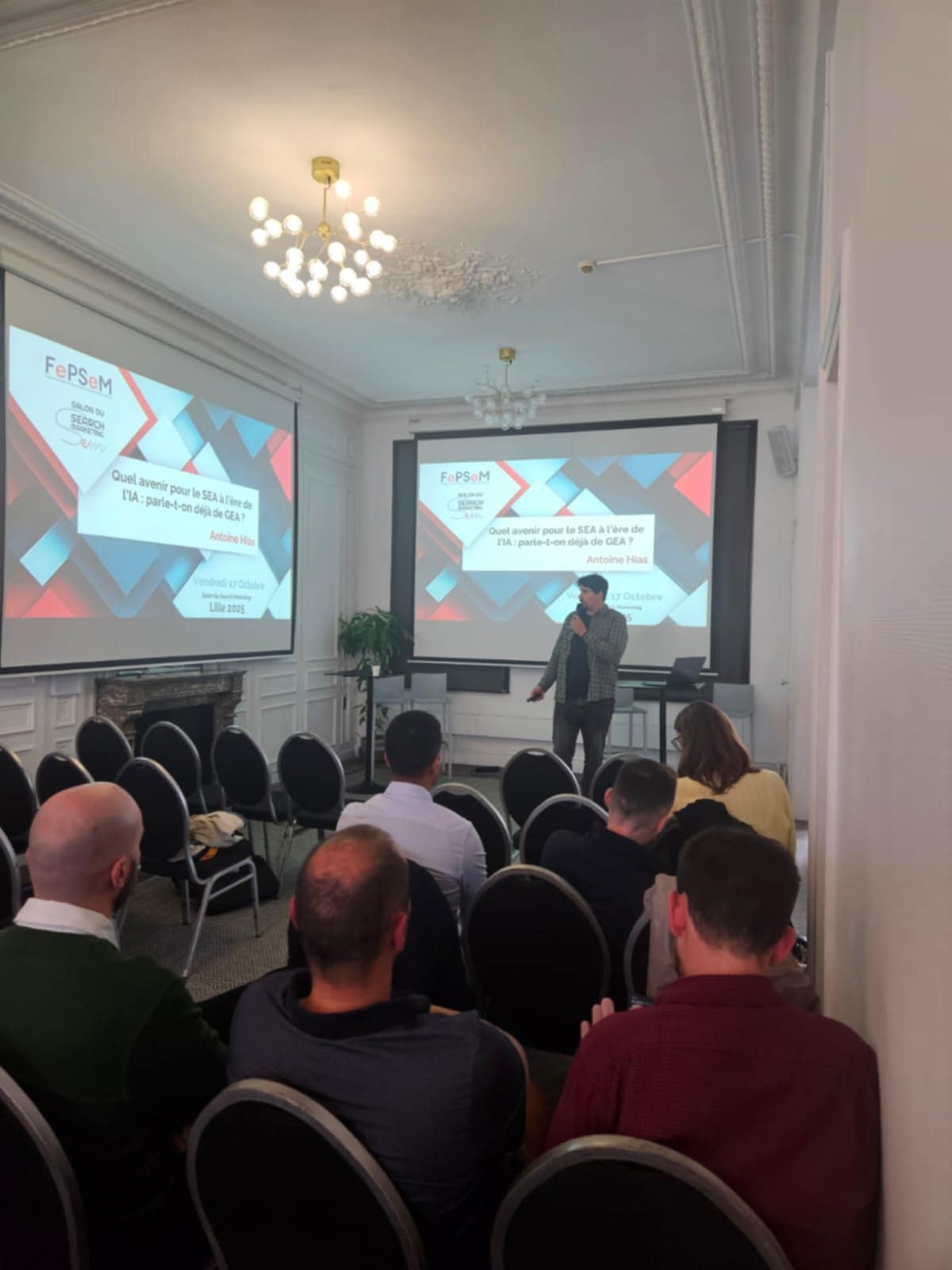

Generative AI is reshaping SEO by delivering synthetic, contextualized answers that can reduce traditional organic traffic by up to 50% on certain queries. GEO (Generative Engine Optimization) is becoming essential to be cited by AI systems as a trusted source, combining expertise, structure, and fresh content. Google’s 2025 algorithm updates strengthen E-E-A-T criteria, penalizing mass-generated content and rewarding quality and user experience. Google’s AI Overviews, rolled out at the end of 2025, capture a significant share of clicks, forcing an urgent adaptation of SEO and GEO strategies. Professionals must master understanding LLMs, contextualized editorial strategy, and ethics to succeed in tomorrow’s SEO. The SEO Summit 2025 has established itself as the must-attend annual event for SEO professionals, amid a year marked by major upheavals linked to generative artificial intelligence. The rise of generative search engines (Google SGE, Bing AI, Perplexity, Gemini) is radically redefining the rules of the game: visibility is no longer measured solely by SERP rankings, but by the ability to be cited and used by AIs in their direct responses. This revolution ushers in a new era, where GEO (Generative Engine Optimization) becomes the key to staying relevant and competitive. This detailed report analyzes the main themes of the SEO Summit 2025, drawing on expert insights, concrete case studies, and recent algorithmic changes, to provide a clear and actionable roadmap for agencies, consultants, and marketing leaders. Generative AI is at the heart of SEO transformations in 2025. Unlike traditional search engines, generative engines such as Google SGE, Bing AI, Perplexity, and Gemini provide concise conversational answers, reducing the user’s need to click on links. This shift directly impacts organic traffic: studies show that certain queries have seen traffic drops of up to 50% since the rollout of AI Overviews, particularly for informational queries like marketingautomation.fr+2. The SEO Summit emphasized that this trend is irreversible and that professionals must adapt by optimizing their content for these new response formats. This involves optimizing content not just for ranking in traditional search engines, but to be selected, understood, and cited by generative AIs. It requires clear content structuring (headings, short paragraphs, lists, tables), highlighting expertise and credibility (expert quotes, reliable sources), and regularly updating content to ensure its freshness. SERP changes are also significant. In 2025, Google rolled out several major algorithm updates, including the Google Spam Update and the June Core Update, which emphasize content quality and user experience. The E-E-A-T criteria (Experience, Expertise, Authority, Trustworthiness) have become essential for evaluating a site’s relevance. Mass-produced AI-generated content without human-added value is penalized, while original, contextualized, and well-sourced content is rewarded. AI-First: The Right Content in the Right Place Speakers highlighted the need to clearly define named entities (brands, products, locations) and their attributes so that AIs can correctly understand and cite content. They also showcased tools like Promptwatch and Qwairy, which help analyze connections between concepts and optimize visibility in AI responses. Alan Cladx explored advanced methods for guiding language models, emphasizing the importance of English as the reference language and JSON format for structuring data. Unlike traditional SEO, backlinks do not influence AIs, but citations play a crucial role. He shared innovative techniques, such as generating URLs with instructions to "educate" AIs, or using self-verified sources to strengthen content credibility—an audacious but effective approach to maximize presence in generative responses. Decoding How AIs Work Using Crawl Data: Nicolas Rabouille (Rablab) demonstrated how to analyze server logs to identify the pages most visited by AI bots, dubbed “AI magnets.” With tools like AI Crawl Intelligence, it becomes possible to track visits from “contextualization bots” and optimize content for derived queries. This strategy is essential for anticipating trends and tailoring publications to the expectations of language models. Mikaël Priol (Yooda) presented a revealing study: 83% of sources cited by ChatGPT do not appear in Google’s top 100 results. The most referenced sources? Reddit (50%), Wikipedia (33%), and blogs. He also highlighted visibility factors, such as brand mentions and branded anchors, and recommended using the Netlinking AI Visibility Checker to assess content performance in AI responses. Jacky Giang (Linksgarden) explained how to influence language model databases, notably through Common Crawl, which accounts for 60% of ChatGPT-3’s data. He emphasized the importance of reliable sources (.gov, .edu) and citations, which are far more influential than traditional backlinks. A well-designed off-site strategy can thus shape AI perception and enhance brand visibility. Jacky Giang (Linksgarden) explained how to influence language model databases, notably through Common Crawl, which accounts for 60% of ChatGPT-3’s data. He emphasized the importance of reliable sources (.gov, .edu) and citations, which are far more influential than traditional backlinks. A well-designed off-site strategy can thus shape AI perception and enhance brand visibility. Olivier Duffez compared traditional SEO and GEO approaches, highlighting their commonalities (UX, expertise, conversational content) and the specifics of GEO, such as chunking (structuring content into clear blocks) and embedding (semantic representation). He reminded that brand mentions and content updates are now as important as backlinks. Sylvain Peyronnet detailed the mechanisms of generative search engines, such as RRF (Reciprocal Rank Fusion), which combines source rankings, and thematic expansion, which broadens coverage of search intents. A deep understanding of these processes allows for adapting editorial strategies to maximize visibility in AI responses. Frédérik Bobet addressed the practical challenges of GEO, such as the lack of volumetric data for prompts and result instability. He proposed a method to track AI snippet triggers and analyze brand presence in citations, using tools like the Plugin Scrap ChatGPT. Olivier de Segonzac (Resoneo) closed the Summit by presenting an ideal dashboard for measuring the impact of language models. He detailed the importance of server logs to track AI bot visits, analyzing AI traffic in GA4, and monitoring mentions and citations. A data-driven approach essential for managing GEO strategies. The sessions at SEO Summit 2025 revealed innovative strategies for adapting to the era of generative AI. Experts emphasized that reliability, semantic consistency, and recognized expertise are now essential to be cited by AIs. Emerging tools, such as BrightEdge and the Semrush GEO Toolkit, allow tracking the frequency and context of citations, providing a clear view of opportunities to leverage. Case studies presented showed that contextualized, original content illustrated with concrete examples is more frequently cited by AIs. For instance, an article enriched with a unique case study on managing customer reviews was cited by Perplexity, demonstrating the importance of originality and contextualization. GEO addresses the challenges posed by generative AI by transforming the way content is optimized. It’s no longer just about “ranking” for a keyword, but about becoming a legitimate, memorable, and citable source for AIs. Emerging tools enable tracking the frequency and context of citations, analyzing competition in generated responses, and adjusting strategies accordingly. GEO also requires a new editorial approach, where structure, readability, and content freshness are paramount. Short paragraphs, clear headings, expert quotes, and reliable sources enhance credibility and visibility in AI responses. The SEO Summit highlighted several emerging tools and methods to support the transition to GEO. Predictive AI solutions anticipate search trends and guide content creation toward emerging topics, increasing engagement. A multichannel approach has become essential: a publication optimized for a search engine is simultaneously designed to drive engagement on social media. Tools for enriched SERP analysis and content intelligence platforms help better understand search intents and adapt content accordingly. For example, BuzzSumo identifies viral content and relevant influencers, while Majestic or Ahrefs help analyze backlink profiles to enhance a site’s authority. Automating SEO tasks with AI improves efficiency and visibility in search engines. However, this automation must be complemented by a human touch to ensure content quality and relevance. The outlook for 2025 is clear: generative AI and generative search engines will continue to transform the SEO landscape. Professionals must invest in GEO expertise, rethink their KPIs to include visibility in AI responses, and collaborate with data and AI teams to stay competitive. Mastery of key skills—such as in-depth understanding of LLMs, contextualized editorial strategy, a brand-centric approach, and ethics—is essential. Google’s algorithm updates will continue to reward quality, relevance, and user experience, while penalizing mass-produced, unsourced content. E-E-A-T criteria will remain an essential standard for evaluating a site’s relevance in the SERPs. Finally, professionals must adopt a hybrid approach, combining traditional SEO practices with the new requirements of GEO, to maximize visibility on both traditional search engines and AI-powered search engines. Traditional SEO GEO (Generative Engine Optimization) Rank in search results Be cited and utilized by generative AIs Keywords, tags, backlinks Clear structure, citations, concrete examples Content optimized for humans and search engines Content optimized for AI, concise and unique Important, impacts ranking Less prioritized, focus on content quality Google Analytics, Ahrefs, SEMrush BrightEdge, Semrush GEO Toolkit, predictive AI tools Responsiveness to Algorithm Changes Continuous monitoring of AI and algorithm developments The 2025 SEO Summit confirmed that generative artificial intelligence and generative search engines are radically redefining SEO. GEO is emerging as the key to staying visible and relevant in this new landscape. Professionals must adapt their strategies by adopting a hybrid approach that combines traditional SEO with AI optimization, while mastering key skills related to understanding LLMs, contextualized editorial strategy, and ethics. Emerging tools and Google’s algorithm updates reinforce the need for continuous monitoring and agile adaptation. In short, GEO is not optional, but a necessity for succeeding in tomorrow’s SEO. How AI Is Reinventing SEO — and Why GEO Is Essential in 2025
Introduction
Key Themes for 2025: Generative AI, Generative Search Engines, and SERP Transformations
GEO (Generative Engine Optimization) is emerging as a key discipline to address these challenges.
The Key Conferences That Defined SEO Summit 2025
Julien Bismuth (Getfluence) and de Vauxmoret (Uplix) kicked off the Summit by emphasizing the importance of adapting content structure to language models. With 14 billion daily searches on Google and 2.5 billion on ChatGPT, users now favor direct and concise answers. Influencing AIs: The R&D of Tomorrow
How to Appear on ChatGPT: Insights from the Study
Off-Site Influence for AIs
Off-Site Influence for AIs
Traditional SEO vs. AI Optimization: Finding the Balance
Queries, Responses, and Expansion in Generative Search Engines
Meeting Client Expectations in GEO
Measuring the Impact of AI Engines: Metrics and Actions
Key Takeaways
GEO in Response to the Challenges of Generative AI
Emerging Tools and Methods: Towards a Hybrid and Automated SEO
2025 Outlook: Predictions and Strategic Recommendations
Comparison Table: Traditional SEO vs. GEO
Criteria
Main Objective
Optimization
Content
User Experience
Tools
Adaptation to Updates
Conclusion