Skip links

Resources: GEO Blog & Glossary

We share analyses, benchmarks, and best practices to help you understand the stakes of Generative Engine Optimization.

0-9
A
AI Answer Box / AI Summary / AI Snapshot
AI-generated boxes on results pages that provide a summary or direct answer to a query. They often combine information from multiple sources, similar to AI Overviews, and also include links to reference content.
See also: AI Overview, Answer Engine, Enhanced Results.
Google AI Mode
An advanced search experience using deep reasoning and multimodal capabilities to explore a topic in detail. It allows follow-up questions, provides links to useful resources, and integrates AI-generated answers. AI Mode notably relies on the query fan-out technique to break a query into sub-questions and explore the web in depth.
See also: Query fan-out, SGE, AI Overview.
AI Overview
AI-generated summaries displayed on Google results pages, combining information from multiple sources. They provide a quick overview of a topic, with links to relevant content, often in a prominent area at the top of the SERP. AI Overviews extend the Search Generative Experience and rely on Google’s advanced models.
See also: SGE, AI Mode, AI Answer Box.
Answer Engine / Response Engine
A system that directly answers questions by computing or generating a response from external data (e.g., WolframAlpha). Unlike traditional search engines, it provides a precise answer rather than a list of links. It relies on knowledge bases, algorithms, and sometimes language models.
See also: AEO, AI Answer Box, Answer Box.
Answer Engine Optimization (AEO)
Content optimization to appear in direct answers provided by answer engines or conversational assistants. AEO focuses on content structure, clarity, and reliability so that AI systems can accurately retrieve and cite it. It specifically targets answers generated by tools like ChatGPT or Google’s AI Overviews.
See also: GEO, Answer Engine, Enhanced Results.
But truly, them
also accuse them and assign them the just and worthy punishment of those who cause the suffering of others.
B
Vector database
A database designed to store and query embeddings (vectors representing the meaning or features of unstructured data). Unlike traditional databases, it handles multidimensional data and searches by similarity (distance between vectors). It powers semantic search and RAG by providing relevant documents through vector queries.
See also: Embeddings, Semantic Search, RAG.
C
Chunking
The act of breaking large volumes of text into smaller units, called “chunks,” to make them easier for language models to process. This improves the efficiency and accuracy of summarization, information extraction, or translation. Chunks may consist of sentences, paragraphs, or passages, in order to preserve relevant context.
See also: Passage, Context Window.
Citation
Explicit mention of a source or document in the response generated by a model, used to reference the origin of the information. RAG systems and AI Overviews use citations to show which pages were consulted and to strengthen user trust. Structuring your content and providing reliable sources increases the chances of being cited.
See also: RAG, AI Overview, E-E-A-T.
D
Data ingestion
The process by which raw data is collected, imported, and integrated into a system for processing or analysis. For language models, this includes gathering texts, cleaning them, and formatting them for training or updating via techniques like RAG. Effective ingestion ensures the quality and freshness of the information used by generative engines.
See also: RAG, Grounding, Vector Databases.
Structured Data
A standardized format used to provide information about a page and classify its content (e.g., a recipe: ingredients, cooking time, nutritional value). This markup helps engines understand the content and supports the generation of enriched results and the use of the page by language models.
See also: Schema.org, JSON-LD, Enhanced Results.
E
E-E-A-T
Acronym for Experience, Expertise, Authority, Trustworthiness. This is a content quality evaluation framework used by Google. Experience reflects first-hand knowledge of the topic; expertise refers to skills or qualifications; authority concerns reputation and the quality of sources; trustworthiness relates to site security and transparency. Strengthening these criteria improves content credibility and visibility, even though they are not direct ranking factors.
See also: YMYL, LLMO, Rich results.
Embeddings
Vector representations (in numerical form) of words, phrases, or objects, organized so that semantically similar items are close in the vector space. Obtained through learning techniques, they allow measurement of semantic similarity between texts or entities. They are used for semantic search, sentiment analysis, and information retrieval in vector databases.
See also: Semantic similarity, Vector database, Semantic search.
Entity / Named Entity
An important element of a text (person, place, organization, event, date, etc.) that can be detected and categorized using named entity recognition techniques. Identifying entities feeds knowledge graphs and improves search relevance. In GEO, properly defining and tagging entities enhances their recognition by models and increases the likelihood of being cited.
See also: Knowledge Graph, Schema.org, Embeddings.
F
Featured Snippet / Position Zero
A highlighted text snippet at the top of a search results page that provides a concise answer to a query. It is called “position zero” because it appears before the organic results, often in a box. It is selected from well-structured and relevant content, making it important for SEO and GEO.
See also: Enhanced Results, Zero-Click Search, AI Answer Box.
Context Window
The maximum number of tokens a model can consider simultaneously around a word or query. A larger context window allows the model to retain more information and can improve response relevance. It determines how much text an LLM can analyze at once and influences chunking and RAG strategies.
See also: Token, LLM, Chunking.
G
Generative AI Optimization (GAIO)
Term used to describe the optimization of content to adapt it to generative engines (the conceptual equivalent of GEO). It combines structuring, markup, and semantic relevance so that language models recommend and cite a brand’s content. GAIO largely overlaps with GEO.
See also: GEO, LLMO, AEO.
Generative Engine Advertising (GEA)
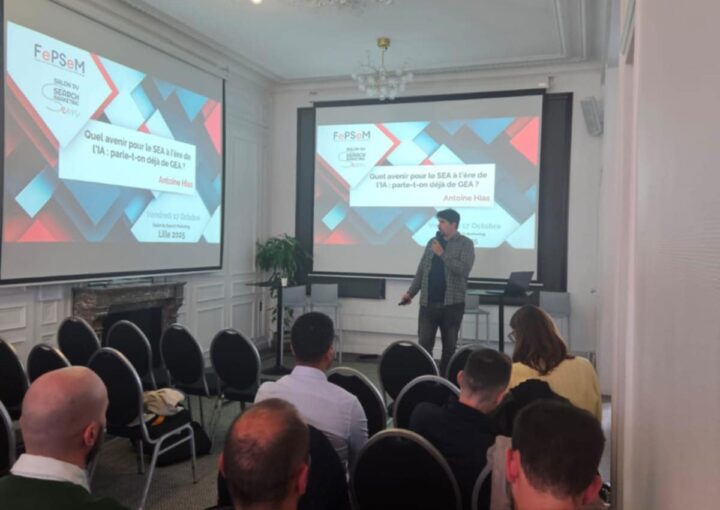
Adaptation of advertising strategies to optimize brand visibility and recommendations within AI-generated responses. This involves creating promotional content that is likely to be selected and mentioned by generative engines such as ChatGPT or Perplexity. GEA extends GEO by specifically targeting the commercial recommendations made by the models.
See also: GEO, LLMO.
Generative Engine Optimization (GEO)
This refers to the optimization of digital content to improve its visibility in results generated by AI models, particularly the synthetic answers produced by generative engines.
This practice aims to influence the way large language models retrieve, synthesize, and cite a brand’s or publisher’s information in generated responses.
It resembles an evolution of search optimization toward environments where users receive a complete answer without clicking, and it is distinct from Search Engine Optimization (SEO) and Answer Engine Optimization (AEO).
Also called: GAIO, AI SEO, generative engine optimization. See also: AEO, RAG.
Generative Search Optimization (GSO)
A set of optimization techniques aimed at ensuring content is effectively recognized by search engines using generative AI. Similar to GEO, AEO, and GAIO, it emphasizes semantic quality and the accessibility of information for the models, whether in generated answers, enriched results, or knowledge panels.
See also: GEO, Global GSO, LLMO.
Global Search Optimization (GSO)
A set of optimization practices aimed at improving the visibility of content across all search interfaces: traditional search engines, voice assistants, generative engines, etc. It combines SEO, AEO, and GEO to ensure presence in organic results, direct answers, and generated previews.
See also: SEO, GEO, LLMO.
Grounding / Factual Anchoring
The act of linking an AI model’s output to real, verifiable data to ensure factual results. Grounding improves accuracy by basing generation on authentic documents rather than mere statistical correlations. It is often used alongside RAG to combat hallucinations and provide clear citations.
See also: RAG, Hallucination, Generative AI.
H
Hallucination (AI)
Inaccuracy or false statement generated by an AI model, while appearing plausible. It occurs when the model misinterprets patterns or lacks reliable information, producing responses that do not reflect reality. Reducing hallucinations involves techniques such as RAG or grounding, which link the output to verifiable sources.
See also: Grounding, RAG, Generative AI.
I
Generative AI
A set of models capable of creating text, images, or other original content from existing data. Often based on transformer architectures and LLMs, generative AI produces responses, summaries, or multimodal creations and powers conversational assistants and creative tools. It also raises reliability and ethical concerns.
See also: LLM, Foundation AI, Hallucination.
Search Intent
What the user actually wants to achieve when entering a query: informational (seeking a fact), transactional (purchasing or booking), or navigational (accessing a specific site). Understanding the intent allows content and responses to be tailored to better meet the need.
See also: Conversational Search, Query Fan-Out, Enriched Results.
J
JSON-LD
Serialization format for linked data that allows structured data to be embedded within HTML using JSON. Recommended by Google for implementing Schema.org without modifying visible content, it simplifies markup maintenance and promotes the appearance of enriched results and knowledge panels.
See also: Structured Data, Schema.org, Knowledge Graph.
K
Knowledge Graph
Knowledge Graph: a knowledge base that represents entities and their relationships as nodes and edges. It stores interconnected descriptions of objects, events, and concepts, allowing navigation between them via queries. Search engines use it to power knowledge panels and generated answers.
See also: Named Entity, Schema.org, Knowledge Panel.
Knowledge Panel / Panneau de connaissance
Box in search results that presents a summary of information from a knowledge graph (key facts, images, links, etc.) about an entity. Optimizing its presence involves using structured data and precise schemas for the relevant entities.
See also: Knowledge Graph, Schema.org, Enriched Results.
L
Large Language Model (LLM)
Large language model trained in a self-supervised manner on very large volumes of text for natural language processing tasks. Based on transformer-type architectures, it contains billions to trillions of parameters and can generate, summarize, translate, and reason over text. LLMs are at the core of conversational agents, code generators, and augmented search systems.
See also: Generative AI, Transformers, Context Window.
Large Language Model Optimization (LLMO)
Optimization of content so that it is used and cited by generative AI tools (ChatGPT, Perplexity, etc.). It prioritizes authoritative sources, semantically complete content blocks, and formats that are easy to analyze. LLMO is a variant of AEO and GEO focused on large language models.
Also called: AI SEO, LLM SEO. See also: GEO, AEO.
M
Multimodal Model / Multimodal Search
AI model capable of understanding and processing multiple types of information (text, image, audio, video) simultaneously. Multimodal search leverages these models to interpret queries combining multiple media and provide integrated results (e.g., describing an image and asking a question).
See also: Foundation AI, LLM, Transformers.
N
Natural Language Processing (NLP)
Natural Language Processing (NLP): a field that enables machines to understand, analyze, and generate human language. It covers syntax analysis, translation, entity recognition, sentiment analysis, and more. Recent advances rely on LLMs, embeddings, and pretraining to enhance human–machine interaction.
See also: LLM, Transformers, Embeddings.
O
Ontologie
Formal representation of the concepts within a domain and the relationships that link them, used to structure knowledge. It defines classes, properties, and hierarchies to ensure a shared understanding (for both machines and humans) of a subject. Ontologies are crucial for knowledge graphs and support semantic search and enriched results.
See also: Knowledge Graph, Taxonomy, Schema.org.
P
Passage
Text segment short enough to be processed or indexed individually. Passages are often created through chunking and serve as units for search or input into generative systems. A well-defined passage improves accuracy by focusing on a specific context.
See also: Chunking, RAG.
Prompt
Natural language text that describes the task an AI model should perform. It provides the initial context and can specify the style, format, or information to use. The quality and precision of the prompt directly influence the relevance of the responses and form the core of prompt engineering.
See also: Prompt Engineering, Query Fan-Out, Conversational Search.
Prompt engineering
The art of formulating and structuring an instruction (prompt) to obtain more relevant responses from a generative AI model. A prompt describes the task to perform, sometimes including the desired style, format, or context. Optimizing it is essential to fully leverage language models in both search and creative applications.
See also: Prompt, Query Fan-Out, Conversational Search.
Semantic Proximity
Measure of the similarity in meaning between two words, phrases, or entities within a vector space. Calculated from embeddings, it allows finding relevant content beyond simple keyword matching. It is essential for semantic search and content alignment in answer engines.
See also: Embeddings, Semantic Search.
Q
Query Fan-Out
Technique that breaks a question into multiple subtopics and simultaneously sends several queries to find diverse content. It helps capture different intents and retrieve results from the web, knowledge graphs, and other sources. Query fan-out powers generative search experiences such as AI Mode.
See also: AI Mode, SGE, Conversational Search.
R
Conversational Search
Search where the user asks questions in natural language and receives responses as in a conversation. It replaces keyword-based searches with full queries and offers a more human-like interaction. These systems rely on language models and context to understand intent and provide evolving answers (often via chatbots or voice assistants).
See also: Answer Engine, Search Intent, Prompt.
Zero-Click Search
Search where the answer to the query is provided directly on the results page, without the need for an additional click. This can take the form of rich snippets, knowledge panels, or generated answers that immediately satisfy the search intent. This trend impacts GEO and AEO, as it reduces site traffic in favor of presence in the immediate answer.
See also: Enriched Results, AI Overview, Featured Snippet.
Semantic Search
Information retrieval approach that aims to understand intent and contextual meaning rather than relying solely on exact keywords. It leverages embeddings and measures semantic similarity to deliver more relevant results, particularly for conversational queries.
See also: Embeddings, Semantic Proximity, Vector Database.
Enriched Results
Search results that go beyond the traditional blue link, displaying additional data, images, or visuals (reviews, products, events, etc.). They are often generated from structured data. They enhance the user experience and can achieve high click-through rates, even with the rise of zero-click searches.
See also: Structured Data, Rich Snippet, Featured Snippet.
Retrieval-Augmented Generation (RAG)
Technique that combines a language model with an information retrieval system to incorporate up-to-date knowledge into generation. The model first consults a set of specific documents before responding, which enriches the output and reduces hallucinations. It allows updating a model without full retraining and facilitates verifiable citations.
See also: GEO, Grounding, Augmented Retrieval.
Search or Crawl Bots
Programs that automatically browse websites to download and index their content. They allow search engines to discover and update pages, but also serve to collect data for training language models. Publishers can control their activity using the robots.txt file and certain meta tags.
See also: Knowledge Graph, LLMO, Web Crawling.
S
Schema.org
Collaborative initiative aimed at defining schemas for structured data on the Internet. Led by players such as Google, Microsoft, Yahoo, Yandex, and the web community, it provides common tags to improve search engines’ understanding of pages. Using Schema.org in HTML helps generate enriched results, knowledge panels, and accurate citations.
See also: Structured Data, JSON-LD, Knowledge Graph.
Search Generative Experience (SGE)
Experience from Google Search Labs that uses generative AI to provide quick overviews of a topic, related ideas, and the ability to ask follow-up questions. SGE presents synthesized answers accompanied by links to sources, helping users understand a topic more quickly. It paves the way for more conversational search and has inspired AI Overviews and AI Mode.
See also: AI Overview, AI Mode, Query Fan-Out.
SEO LLM / LLM SEO
Informal term referring to the optimization of content so that it can be utilized and cited by large language models. Similar to LLMO, it involves structuring content, providing reliable sources, and maximizing the models’ semantic understanding. It combines traditional SEO and GEO to ensure visibility in generated answers.
See also: LLMO, GEO, AEO.
T
Taxonomy
Hierarchical classification used to organize concepts, products, or content into categories and subcategories. It facilitates user navigation and search engine indexing. In GEO, a consistent taxonomy helps models understand relationships between topics and generate more accurate responses.
See also: Ontology, Knowledge Graph, Structured Data.
Token
A sequence of characters considered a processing unit during tokenization (word, subword, symbol, etc.). Tokenization splits text into tokens, which the model then processes. The number of tokens affects the context window and processing costs.
See also: Context Window, Transformers, Embeddings.
Transformers
Neural network architecture based on the multi-head attention mechanism, without recurrence. Text is tokenized and embedded, then each token is contextualized via attention weights within a context window. Introduced in the paper “Attention Is All You Need” (2017), transformers have replaced RNNs and form the basis of most large language models.
See also: LLM, Context Window, Token.
U
V
W
X
Y
YMYL (Your Money or Your Life)
Category of content that can impact users’ health, safety, happiness, or financial stability. Google applies higher quality standards to these pages to prevent inaccurate information from harming users. Publishers must demonstrate strong expertise and trustworthiness to be visible in these sensitive areas.
See also: E-E-A-T, Enriched Results, LLMO.
Z
This website uses cookies to improve your web experience.